Many experiences in the modern world increase stress, whether exciting things we look forward to, or worrying things we don’t. They still create stress. Stress is the body’s response to a challenge. So when something pops into your mind that is a challenge, your body responds with stress. You don’t actually have to experience it. You just need to think about it.
There are many studies on stress. partly because stress is easy to measure: you can measure their heart rate, blood pressure, and skin conductivity, all of which indicate stress.
Much of the time, when we’re stressed, we don’t realise it. We know this because people are asked, and their behaviour is monitored, while stress is monitored, and often they don’t notice. (Many variations of the Iowa gambling task indicate this.)
This is unhealthy, but it isn’t human physiology that is unhealthy. It’s the environment. We are nomadic hunter-gatherers, and the secret is in the nomadic bit. Nomadic hunter-gatherers are nomadic. They move around. They travel light. If there were a plague of venomous spiders and snakes in a particular area, they’d leave. If there were hostile competitors, they’d move away from them. The world has been big enough for every human. But now we’re all squeezed in together, and we have to deal with each other and each other’s problems as well as our own. And we also have to deal with how other people deal with their problems.
Stress is a feeling. An uncomfortable feeling, and that’s a good thing, because we don’t want to feel comfortable in places where we’re under threat. We want to be motivated to address the threat rather than ignore it. Irrespective of all of that fine strategy, here we are. And people barge in your way. Their insecurity leaks into your life, and your own insecurity is heightened as a result. Our behaviour reflects the behaviour of the people around us. And this all just goes round and round. It’s a big negative feedback loop.
Now, life isn’t always like that. Obviously, we seek out people and groups that neutralise that, or make us feel better. But it’s a thing.
So how do we intervene in this? We intervene in that by relaxing. It’s as simple as that. When I say it’s simple, it’s an absolutely crystal-clear, totally obvious, easily explained, and reliably empirically supported fact that the way to resolve stress is to relax.
That’s why, when we start class, I teach you posture, because it relaxes you. The little biohacks relax you, too: the chin mudra, sitting with your elbows by your sides, your tongue up against the back of the top teeth, in contact with the sharp part of the bottom teeth. With all of this, you’re learning to relax, and you’re learning how to change your psychophysiological state.
This takes time and practice. Unfortunately, feedback and mind loops are habits we built up over decades. It takes years to replace them.
There’s a little bit of marketing I did: a photograph of a hole in a roof that said, “Susan’s got a hole in her roof.” When it rains, she can’t get up there to fix it. When it doesn’t rain, she doesn’t need to fix it. So the hole stays there, and then, over time, another hole gets added, and another. And then, before you know it, she has a leaky roof, and there are buckets everywhere. This is what happens if we don’t have the mental and physical training to manage our stress.
So what you need to do is train yourself to notice the present moment, and in the process, you are learning to notice the stress. All you need to do is train yourself to notice you’re here, and your subconscious will make you more aware of those situations where there’s some sort of stress. Your subconscious is always on your side. It’s just has a different idea of what benefits you than you do. The subconscious wants you to get up now, walk away from all this, walk into nature, find a group of people you love, and live in the forest with them. That’s it. And if there’s any trouble, it wants you to move somewhere else. You don’t really want houses, cars, home improvements, or foreign holidays. You don’t. You just want nature and the people you love. That’s it. Escapism, distraction, comfort, and pleasure are what we need when we can’t have the connection we really need.
So we’ve got the relaxation, we’re training ourselves to be here now. We need to focus on the present moment so we can choose how we use our minds. Because if you’re in a narrative or a mental movie, you don’t have that choice. You are lost in the stories of the mind.
Worriers have this idea that their worrying solves problems. No. Planning solves problems. If you find yourself worrying and you’re saying to yourself, “Okay, I need to think about this to solve these problems. I need to worry about this, I need to worry about that”, replace “worry” with “plan”. Then book some time into your calendar to do it and stop worrying!
How many times do you need to think about any one thing? If someone pushes in front of you, how many times do we need to think about it? As many times as is necessary to learn the lesson from it, if there’s a lesson to be had. And if there isn’t a lesson to be learned, we don’t need to think about it at all.
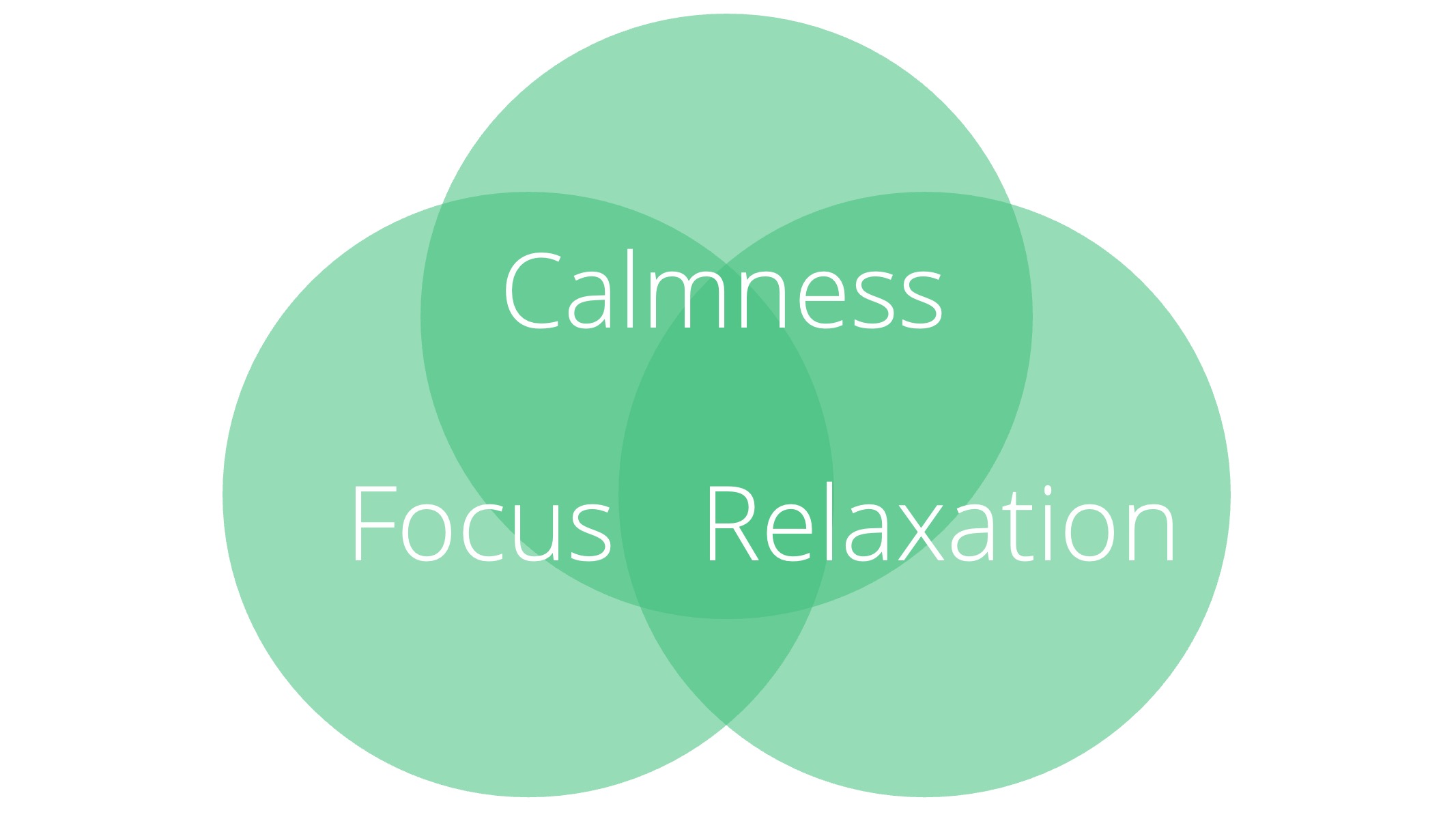
So, with all of this awareness, it’s the combination of training ourselves to be present through focused attention and meditation, being able to intervene in our stress to focus, and then maintaining that focus on the present moment. And then the mind becomes relatively calm, enabling us to choose how to use it and what choices to make. And from that point on, you’ve got a tool set that you can use in the future: relaxation, focus, and calmness.
And once you’ve done that a few times, you’ve trained your subconscious, and it knows where to go now. The dog knows where to go to get its bone, and the mouse knows where to go to get its cheese. It’s not likely to be forgotten. You know where to go to find your calmness; you won’t forget.