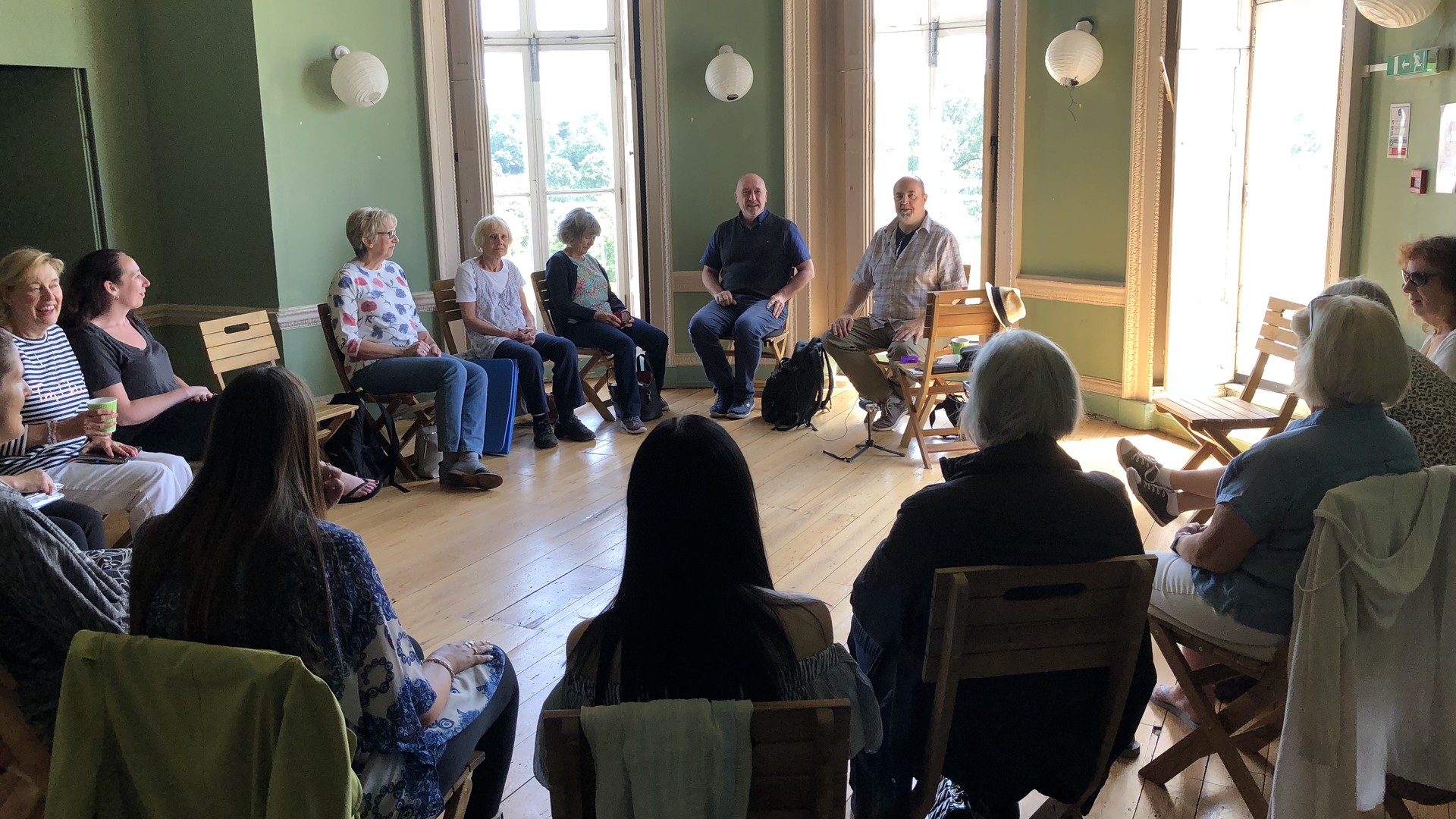
I am often asked what actually happens on the course. Not what it promises, but what it’s like to turn up on a Tuesday evening, sit down with a group of strangers (at first, though we get to know each other over the five weeks) and spend two hours learning about your own mind. This is a fair question, and the unknown can be the biggest thing standing between you and the door.
Here is an introduction to the experience.
First, what it isn’t
I explain that the course isn’t therapy, and it isn’t religious. Nothing I teach should contradict either. I invite students to tell me if that ever happens, and I am pleased to say that in ten years of teaching the course, I have always resolved any apparent contradictions.
Mindfulness complements many systems and methodologies because it teaches us to be present and helps us put into action what we learn from these other systems.
I don’t teach the kind of meditation you’ll find by the thousand on YouTube. The meditations that I teach are mental training designed to help you become familiar and comfortable with your mind. The course is built around this.
I have had students in the course who were totally new to meditation. And also students on a course who have meditated for years. It really makes no difference. Every group is different.
Why Resilience?
I teach Mindfulness-Based Resilience. Resilience is about coping with adversity. The encouraging part, and it’s well researched, is that resilience can be learned. This course is designed to give you a set of skills you can keep using for your entire life.
What the evenings feel like
Each session is two hours. It includes a combination of teaching from me, meditation practice, a coffee break where the best questions usually come out, and room for conversation for those who want to discuss the content.
You get a handout every week, so you don’t need to take notes unless you want to. The sessions are recorded, so if you can’t make one, I send you the recording. If getting to the class in person is difficult one week, you can join on Zoom instead.
I take a very soft, gentle approach to homework. In fact, I don’t call it homework. There are optional practices, and most of it is supported by online recordings, some of which are in a podcast app, so it’s nice and easy to access.
A walk through the five sessions
Session 1: an introduction to mindfulness and meditation
In the first class, I introduce myself. I explain the training, I talk about the venue, I explain how we are informal and that you can leave the room at any point if you need to take a call or make a call, or stretch your legs, or get a glass of water or any such thing.
The first class is a whiz-bang, fast-paced explanation of meditation, mindfulness, the mind and some insights into the modern mind, and how and why it responds to the modern world the way that it does.
I’ll introduce you to the frameworks that I use for learning meditation. And what the rest of the course will consist of.
Session 2: Stress, and what to do about it
The stress management component of the course has moved forward to the second class because I’ve learned that, although many people come to mindfulness and meditation because of stress, that same stress gets in the way of their meditation. The earlier you learn stress management and tools and techniques that help you intervene in your stress, the better, because you can learn to relax and calm yourself down early in your practice. And that will give you the focus to get the best from the rest of the training.
This class is less theory and more practice, and it will provide much of the foundation you need to build on in your meditation practice.
In this class, I cover breathwork, explain stress, and help you learn what it really is and what we can do about it. The good news is that many tools can help us intervene in our stress, relax, focus, and calm our minds.
Session 3: How the mind works, and how to work with it
This class is highly practical. I explain meditation as a training system, how it is a bit like the forms (structured movements the practitioners learn by heart) in a martial art: you practise the skills so that when life becomes difficult, you have already integrated the skill and it has become part of you. That is our eventual goal.
A key idea this week is the difference between outer work and inner work. Push a bottle harder, and it moves further. Try that with your mind, and it often pushes back.
We look at focus and perception, and I introduce labelling, a way of observing your thoughts as they arise. I also introduce you to the Frictionless Way: a set of practices that give the greatest benefit for the least effort, and how to fit meditation into walking, commuting, lying in bed and the gaps in an ordinary day. There’s a section on sleep and deep relaxation that many people find useful, and I introduce the Energy Tree, my sleep, rest and energy meditation and breathwork framework.
Session 4: Thoughts, emotions and seeing things differently
Session four is about working with thoughts and emotions. This can sound daunting, but we don’t train ourselves by confronting our inner state. We train ourselves to align with our inner state to guide our mind by understanding it, rather than trying to control it.
In this class, I introduce you more deeply to perception. And we learn how we construct our mental models and how we can reconstruct them more helpfully.
I explain how to measure your progress in meditation and mindfulness. Progress isn’t linear; it’s two steps back and three steps forward, and the two steps backwards are very real. We can get distracted; we can get diverted; we can fall out of practice, just like with everything else. And this is about building our practices in a sustainable way that enables us to maintain them and incrementally improve our life over time.
We also learn how to neutralise unhelpful thought patterns.
Session 5: The emotional resilience toolkit
The final session brings it all together. We come back to resilience, and this time add connection: with other people, and with our minds and bodies, and the signals we get back from them as we go through our lives.
I introduce my Loving Awareness methodology: a set of practices that work with our warm, comfortable feelings. Having access to these skills helps us cultivate warm, comfortable, connective emotions and rebalance life experiences that feel repetitive, persistent, unhelpful, and uncomfortable. Through these warm feelings, we reconnect to our physiology and our feelings in our mind in a way that leaves us feeling neutral at worst and joyful at best.
I finish the course by explaining all of the options that you have to continue your training.
Week six and onwards
Five evenings on their own will only change so much, and I never ask anyone to expect that. People benefit greatly from the course and never look back, but we can all find ourselves drawn back into the complexity of our lives. We let go of those things that benefit and support us. Because of that, over the last decade I have built an extended framework of training and support for my students, many of whom have attended my training for many years. I can’t say that it works for everyone, but I know without doubt that it does work for many and very well, based on what they tell me.
As part of the course, you get two optional 20-minute one-to-one calls with me, three free months on The Meditation Course with live online classes every week, and six months of email and phone support once the course has finished. You’ll also join our community. Over the years, Bromley Mindfulness has changed from being a mindfulness and meditation teacher and his students to become a journey of friends connecting and meeting together at retreats, classes, workshops and courses so nobody has to feel like they’re the only meditator in town. Like I did for many years!
There’s also a 100% money-back guarantee, because I would rather you try it than wonder whether it will work for you.
So what is it like?
It’s a group of ordinary people, most of them busy and a bit frazzled, learning to become familiar and comfortable with their own minds. It’s practical, down-to-earth, and often funny. And for many people it’s the start of seeing life through a new lens.
If you’d like to join the next course, in person in Bromley Common or online on Zoom, all the details are here: https://bromleymindfulness.org.uk/mindfulness-courses/